
HDFC Bank Crisis Explained: What Went Wrong & Why Markets Panicked
STOCK MARKETBANKFEATURED
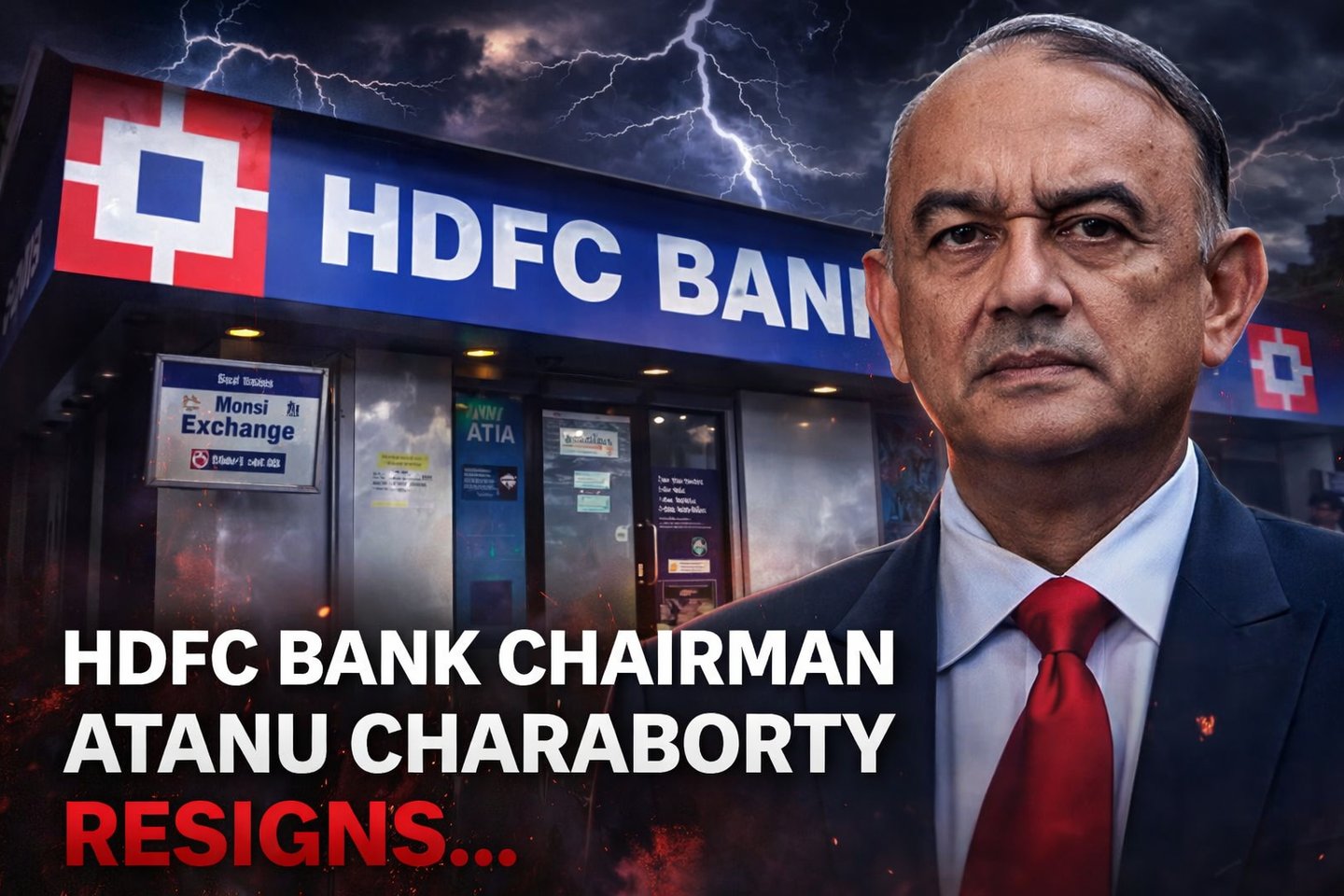
What initially looked like a routine resignation quickly turned into a full-blown trust crisis, wiping out billions in investor wealth and raising serious questions about the bank’s internal practices and structural challenges.
Let’s break this down step-by-step.
🚨 Why Did HDFC Bank Stock Crash in 2026?
India’s second-largest private lender, HDFC Bank, recently found itself at the centre of a massive financial storm. What initially appeared to be a routine leadership change quickly escalated into a full-blown crisis that shook investor confidence and dragged the entire Indian stock market down.
The impact was immediate and severe. The stock fell by nearly 8.7% in a single trading session, while the Nifty 50 index dropped more than 3%, marking its worst day since June 2024. This sharp fall was not surprising, considering HDFC Bank carries approximately 12% weight in the Nifty 50. When a stock of such significance declines, it inevitably pulls the broader market down with it. Within days, the stock hit a 52-week low of ₹750 and further slipped to ₹731, wiping out between ₹70,000 crore and ₹1 lakh crore in market capitalisation.
🔍 The Real Trigger: Chairman Resignation Shock
The crisis began with the resignation of HDFC Bank Chairman Atanu Chakraborty. In his resignation letter, he mentioned that certain happenings and practices within the bank over the past two years were not aligned with his personal values and ethics. This statement immediately raised concerns, as it hinted at deeper issues within the organisation.
However, what made the situation worse was the lack of clarity. The letter did not mention any specifics, names, or concrete examples. Shortly after, Chakraborty clarified in an interview that there was no wrongdoing and that his resignation was due to ideological differences. This contradiction between “values and ethics” and “no wrongdoing” created confusion among investors.
In financial markets, uncertainty is often more damaging than bad news. Investors did not know what to believe, and as a result, panic selling intensified.
💣 AT1 Bonds Controversy Explained
🧠 What Are AT1 Bonds?
To understand one of the core issues, it is important to understand Additional Tier-1 (AT1) bonds. These are high-risk financial instruments that offer higher interest rates compared to traditional bonds. However, unlike normal bonds, they do not have a fixed maturity date, and the issuer is not obligated to return the principal amount.
In extreme financial stress scenarios, these bonds can be completely written off, meaning investors can lose their entire investment. In simple terms, AT1 bonds offer higher returns but come with significantly higher risks.
⚠️ What Happened With HDFC Bank?
Around 2021, HDFC Bank’s Dubai branch reportedly sold Credit Suisse AT1 bonds to Non-Resident Indian (NRI) clients. These bonds were marketed as safe, high-yield investment products offering returns between 10% and 13%.
However, according to reports, the risks associated with these bonds were not adequately disclosed. Investors were not clearly informed that these instruments had no maturity date and could potentially be written off entirely.
💥 Credit Suisse Collapse (2023)
The situation turned disastrous in March 2023 when Credit Suisse collapsed. In an emergency rescue, UBS acquired the bank, and Swiss regulators decided to write off approximately $17 billion worth of AT1 bonds.
As a result, investors holding these bonds lost their entire investment overnight. Although courts later intervened and partially reversed the decision, the bonds recovered to only about 30% of their original value. For many investors, the damage had already been done.
🏦 HDFC Merger Problem: The Hidden Profit Pressure
🧠 How Banks Make Money
Banks primarily make money by borrowing at lower interest rates and lending at higher rates. The difference between these rates is known as the Net Interest Margin (NIM), which is a key indicator of a bank’s profitability.
⚖️ What Changed After the HDFC Merger?
Following the merger between HDFC Bank and HDFC Ltd in 2023, the bank inherited a massive home loan portfolio worth approximately ₹6 lakh crore. However, it did not inherit enough low-cost deposits, also known as CASA (Current Account Savings Account) deposits.
As a result, the bank had to rely more heavily on expensive fixed deposits, which carry higher interest costs. At the same time, home loans typically have lower interest rates compared to personal or business loans. This combination led to a decline in the bank’s overall profitability.
Consequently, HDFC Bank’s net interest margin dropped from around 4.1% before the merger to approximately 3.35%, which is a significant decline for a bank of its scale.
🏛️ CRR & SLR: The Silent Profit Drain
Another critical factor affecting HDFC Bank is the regulatory requirement of maintaining Cash Reserve Ratio (CRR) and Statutory Liquidity Ratio (SLR).
Banks are required to keep around 21% of their deposits locked in reserves. This includes 3% as CRR, which earns no interest, and 18% as SLR, which is invested in government bonds.
Before the merger, HDFC Ltd operated as a Non-Banking Financial Company (NBFC) and was not subject to these requirements. However, after the merger, the entire loan book became subject to CRR and SLR regulations.
This resulted in approximately ₹1.3 lakh crore being locked in low-yield or zero-yield assets, significantly reducing the bank’s earning potential.
📉 Loan vs Deposit Imbalance
Another major concern is the imbalance between loans and deposits. Before the merger, HDFC Bank’s loan-to-deposit ratio was around 87–88%, which was within a reasonable range.
However, after the merger, this ratio spiked to approximately 110%, indicating that the bank had lent more money than it had in deposits. Although it has improved to around 98.5% in recent quarters, it still remains above the RBI’s recommended range of 60–80%.
This imbalance puts additional pressure on the bank’s liquidity and funding strategy.
💥 The Core Issue: Trust Deficit
When all these factors are combined—the AT1 bonds controversy, declining margins due to the merger, and the loan-deposit imbalance—the result is a significant loss of investor confidence.
In banking, trust is the most valuable asset. Unlike other industries, banks rely heavily on public confidence. Once that trust is shaken, the impact can be far more severe than any financial metric.
🌍 Why the Market Reaction Was So Severe
The timing of this crisis further amplified its impact. The broader market was already facing uncertainty due to global geopolitical tensions and economic concerns. In such an environment, any negative development in a major institution like HDFC Bank can trigger a disproportionate reaction.
This is exactly what happened, as investors rushed to exit positions, leading to a sharp decline in both the stock and the broader market.
📊 Key Lessons for Investors
This situation offers several important lessons for investors. Firstly, high returns often come with hidden risks, as seen in the AT1 bonds case. Secondly, mergers, while beneficial in the long term, can create short-term structural challenges that impact profitability.
Most importantly, investors must understand that banking is not just about numbers and financial performance. It is fundamentally about trust and confidence.
🔮 Final Thoughts
HDFC Bank has long been considered one of India’s most reliable and consistent performers. However, the recent events highlight that even the strongest institutions are not immune to challenges.
At this stage, the bank’s ability to rebuild trust, improve deposit growth, and stabilise margins will determine its future trajectory.
Because in the world of banking, one principle remains constant:
Numbers can recover, but trust takes time to rebuild.