
How Wars Impact the Stock Market: Best & Worst Performing Sectors (With Indian Stock Picks & Strategy)
LATEST NEWSFEATURED
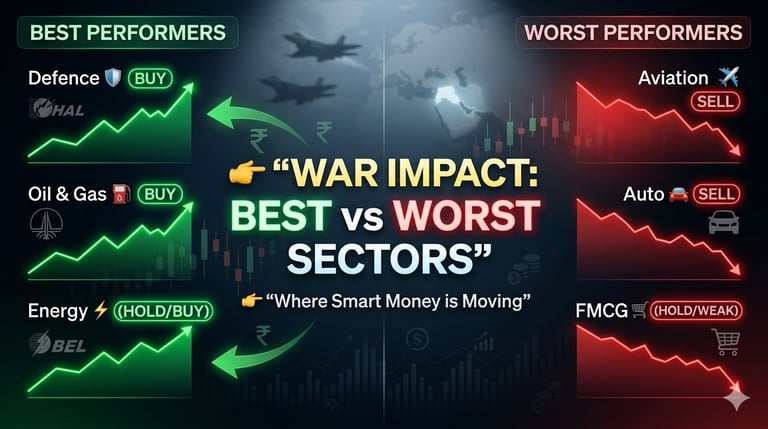
In recent times, rising geopolitical tensions—especially involving Iran, Israel, and the United States—have once again reminded investors of an important truth:
Markets don’t just react to earnings and growth—they react to fear, uncertainty, and global conflict.
In this blog, we will break down:
Which sectors perform well during war-like situations
Which sectors suffer the most
Exact Indian stocks to watch
A practical “war-proof” portfolio strategy
Geopolitical tensions such as the ongoing Iran–Israel–USA conflict have once again shaken global markets. While most investors react with fear and uncertainty, experienced investors understand a crucial principle:
War does not destroy opportunities—it redistributes them.
In this detailed guide, we will analyze how wars impact financial markets, which sectors perform well during war, which sectors suffer, and how Indian investors can build a war-proof portfolio strategy.
🌍 How War Impacts the Stock Market
Whenever a major geopolitical conflict emerges, financial markets tend to follow a predictable pattern. Initially, there is panic selling as uncertainty rises. Investors pull money out of equities and move toward safer assets like gold and bonds.
However, this phase does not last forever.
As the situation evolves, capital begins to rotate into specific sectors that benefit from war-related conditions. These include energy, defense, and essential goods. Eventually, markets stabilize and recover as clarity improves.
Understanding this cycle is critical because the biggest investment opportunities lie in sector rotation—not in panic-driven decisions.
🟢 Best Performing Sectors During War (With Indian Stocks)
🛢️ Oil & Gas Sector – The Biggest Beneficiary
One of the most important stock market trends during war is the sharp rise in oil prices. Conflicts in regions like the Middle East disrupt global supply chains, creating scarcity in crude oil.
As a result, oil-producing companies experience a surge in profitability.
In India, upstream companies such as ONGC and Oil India Ltd directly benefit from rising crude prices because they sell oil at higher realizations. Additionally, conglomerates like Reliance Industries gain from their diversified energy and refining businesses.
This makes oil and gas one of the best sectors to invest in during geopolitical tensions.
🪖 Defense Sector – A Long-Term Structural Winner
Another major beneficiary of war is the defense sector. Governments increase military spending during conflicts, leading to higher demand for weapons, aircraft, surveillance systems, and defense technology.
India’s push for “Atmanirbhar Bharat” (self-reliance in defense) further strengthens this trend.
Companies such as Hindustan Aeronautics Limited (HAL), Bharat Electronics Limited (BEL), Mazagon Dock Shipbuilders, and Bharat Dynamics Limited (BDL) are well-positioned to benefit from increased defense budgets.
Unlike oil, which is cyclical, defense is a long-term growth sector, making it one of the strongest investment themes during and after war.
🥇 Gold and Safe-Haven Assets – Capital Protection
During times of uncertainty, investors prioritize safety over returns. This is where gold plays a critical role.
Gold typically rises during geopolitical crises because it acts as:
A hedge against inflation
Protection against currency depreciation
A store of value during uncertainty
Indian investors can gain exposure through instruments like HDFC Gold ETF or indirectly through companies like Titan Company.
It is important to understand that gold is not meant for aggressive returns. Instead, it acts as a risk management tool in a volatile market environment.
⚡ Power & Utilities – Stability in Uncertain Times
Utilities are considered defensive investments because demand for electricity and energy remains constant regardless of economic conditions.
Companies such as NTPC and Power Grid Corporation of India offer stable cash flows and relatively low volatility.
In a war-like scenario, these stocks provide portfolio stability and downside protection, making them essential components of a balanced investment strategy.
🛒 FMCG Sector – Consistent Demand for Essentials
Even during war, consumers continue to spend on essential goods such as food, hygiene products, and daily necessities.
This makes FMCG (Fast-Moving Consumer Goods) companies highly resilient.
In India, leading players like Hindustan Unilever (HUL), ITC Limited, and Nestlé India tend to perform steadily during uncertain times.
These stocks act as defensive anchors, ensuring consistent performance when broader markets are volatile.
💻 IT & Cybersecurity – The Emerging Opportunity
Modern conflicts are no longer limited to physical warfare. Cyber warfare has become a key component of global tensions.
This increases demand for:
Cybersecurity solutions
Data protection
IT infrastructure
Indian IT giants like Tata Consultancy Services (TCS) and Infosys are likely to benefit from increased global demand for technology services.
However, unlike oil and defence, IT is more of a medium-term opportunity rather than an immediate beneficiary.
🔴 Worst Performing Sectors During War
While some sectors thrive, others face significant challenges.
✈️ Aviation Sector – Severely Impacted
Airlines are among the hardest-hit industries during war because fuel costs rise sharply, and travel demand often declines.
For example, companies like InterGlobe Aviation (IndiGo) face margin pressure due to higher crude oil prices.
🚗 Automobile Sector – Demand Destruction
Rising fuel prices and inflation reduce consumer spending on vehicles. As a result, companies like Maruti Suzuki and Tata Motors often experience slower sales growth.
🧪 Paints & Chemicals – Margin Pressure
These industries rely heavily on crude oil derivatives as raw materials. When oil prices increase, production costs rise, reducing profitability.
Companies such as Asian Paints are particularly affected.
🏗️ Infrastructure & Capital Goods – Delays and Cost Inflation
War creates uncertainty in global markets, leading to delays in large-scale infrastructure projects. Governments may also redirect spending toward defense.
As a result, companies like Larsen & Toubro (L&T) may face short-term challenges.
🛍️ Luxury & Discretionary Spending – Decline in Demand
During uncertain times, consumers prioritize essential spending over luxury goods. This negatively impacts high-end consumption sectors.
⚔️ How to Build a War-Proof Investment Portfolio
A well-structured portfolio can help investors navigate volatility and even benefit from market shifts.
📊 Short-Term Strategy (0–6 Months)
In the early stages of conflict, the focus should be on capital protection and tactical gains.
A balanced allocation may include:
Oil & Gas (to benefit from price spikes)
Defense (to capture increased spending)
Gold (for risk hedging)
FMCG and Utilities (for stability)
This approach allows investors to capitalize on immediate opportunities while minimizing downside risk.
📈 Medium to Long-Term Strategy (6–24 Months)
As markets stabilize, investors should gradually rotate into growth-oriented sectors.
A long-term portfolio should include:
Defence (continued growth potential)
Energy (moderate exposure)
FMCG (consistent demand)
IT (recovery and global demand)
Gold (reduced but strategic allocation)
This strategy ensures a balance between growth and risk management.
🧠 Key Investment Lessons During War
Successful investing during geopolitical crises requires discipline and strategic thinking.
First, investors must avoid panic selling and instead focus on sector rotation. Money does not disappear during war—it simply moves into different industries.
Second, it is important to understand that oil is a cyclical opportunity, while defense offers long-term growth potential.
Third, gold should be used as a hedge rather than a primary return-generating asset. In short,
1. Don’t Panic—Rotate
Markets reward those who shift capital early, not those who react late.
2. Oil Is Cyclical
Energy stocks perform well during conflict but may correct once tensions ease.
3. Gold Is Protection, Not Growth
Use it to hedge risk—not to chase returns.
4. Defence Is a Long-Term Theme
Unlike oil, defence can continue growing even after conflicts end.
Finally, timing plays a crucial role. The best opportunities often arise when fear is at its peak.
💥 Final Thoughts: Where Smart Money Moves During War
During any major conflict, capital consistently flows into three key areas:
Scarcity (Oil and commodities)
Security (Defense and cybersecurity)
Safety (Gold and essential goods)
All other sectors tend to face pressure.
For Indian investors, the goal is not to predict geopolitical events but to understand how they influence capital flows.
Because in uncertain times, those who adapt quickly don’t just protect their wealth—they grow it.