Unprecedented October: Why the Crypto Market Stayed Bearish
EDUCATIONFEATUREDCRYPTOCURRENCY


Bitcoin, the world's largest cryptocurrency, is set for a nearly 5% decline this month, as the digital asset has struggled in recent weeks amid broader market jitters and muted investor risk appetite.
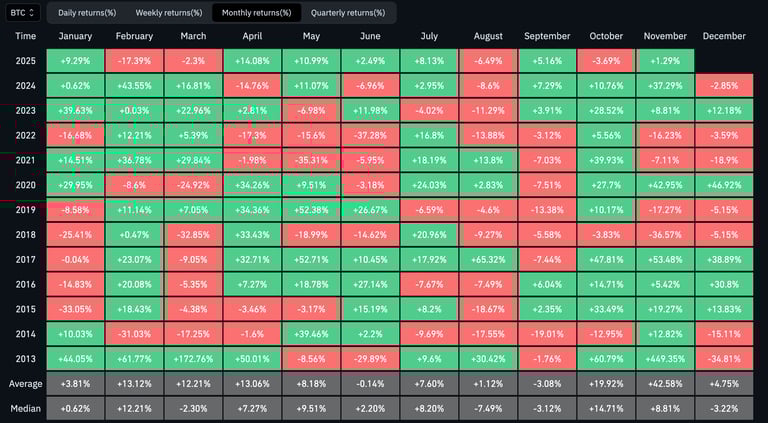
Historically, October has been one of the most bullish months for the crypto market. The only exceptions occurred during major bear markets, such as in 2014 and 2018. That’s why a bearish October in what should be a bull market year is something we haven’t seen before. Fortunately, historical data doesn’t suggest that a weak October guarantees a weak November — though there isn’t much data to go by.
Interestingly, when we look beyond crypto, almost every global asset class — U.S. stocks, international equities, and even precious metals — surged in October. This contrast implies that some hidden factor has been holding back the crypto market. Despite several bullish announcements last week, prices barely moved, confirming that something deeper is at play.
Liquidity Decoupling: A Hidden Drag on Bitcoin
Evidence of this disconnect can be seen in the Global M2 Liquidity vs. Bitcoin chart, which has become less visible across social media lately. Bitcoin began decoupling from global liquidity trends during the summer, and that divergence might explain the market’s persistent weakness since then.
This raises an important question — what exactly is causing this decoupling?
There are two possible explanations:
A crypto-specific factor, such as a major entity collapsing behind the scenes, or
A macro factor affecting crypto more severely than other markets, like stress in the private credit sector.
Is It Just a Narrative? The Unpredictable Market Pattern
Of course, it’s possible that liquidity is just a narrative — not the real reason. The truth might be that crypto is simply moving opposite to everyone’s expectations.
August was expected to be bullish but turned out bearish.
September was expected to be bearish but ended bullish.
October was expected to rally but fell instead.
Following this unpredictable pattern, November looks like a coin toss. In previous cycles, November was bullish in 2013 and 2017 but bearish in 2021. Since recent months have defied historical patterns, relying on seasonal trends may not help this time either.
Catalysts Ahead: Macro and Crypto Triggers to Watch
With history no longer a reliable guide, the only things we can depend on are upcoming catalysts — both macro and crypto-specific. The encouraging part is that many potentially bullish events are lined up for November. The discouraging part, however, is the market’s muted reaction to good news — bullish events often trigger “sell-the-news” reactions, while bearish ones still cause sharp drops.
Still, it’s worth watching these catalysts closely because once the underlying drag on crypto is resolved, they could have a major impact. One key macro event to monitor is the resolution of the U.S. government shutdown, expected around November 21st.
Why the U.S. Government Shutdown Matters for Crypto
Historically, the end of a U.S. government shutdown has corresponded with a decline in the U.S. Dollar Index (DXY) — a move that typically benefits risk assets, including crypto. Recently, the DXY has been climbing, creating a headwind for Bitcoin and altcoins. If the dollar continues to strengthen, it could even threaten the current bull cycle.
Moreover, the shutdown’s resolution will unlock multiple crypto-related regulatory catalysts, including:
Approval of new spot altcoin ETFs by the SEC
The SEC’s long-awaited exemptive relief order
The CFTC relaxing rules for traditional exchanges offering crypto products
However, all of this depends on U.S. lawmakers successfully passing the 2026 budget — a task that seems increasingly difficult amid current political divisions. Cooperation may only come after a full-blown crisis.
The Road Ahead: Expect Volatility
In summary, the crypto market enters November in uncharted waters. Multiple catalysts — both macro and crypto — could influence the trend, but their actual impact may take time to materialize. Until then, traders and investors should wait for a clear directional move.
One thing to note: Bitcoin has consistently bottomed during the first 10 days of every month since July 2024. If this pattern continues, we could be in for another volatile start to November.