
Why Social Security in India Feels “Invisible” — The Reality Most People Experience
INDIAGOVERNMENTSOCIAL SECURITY
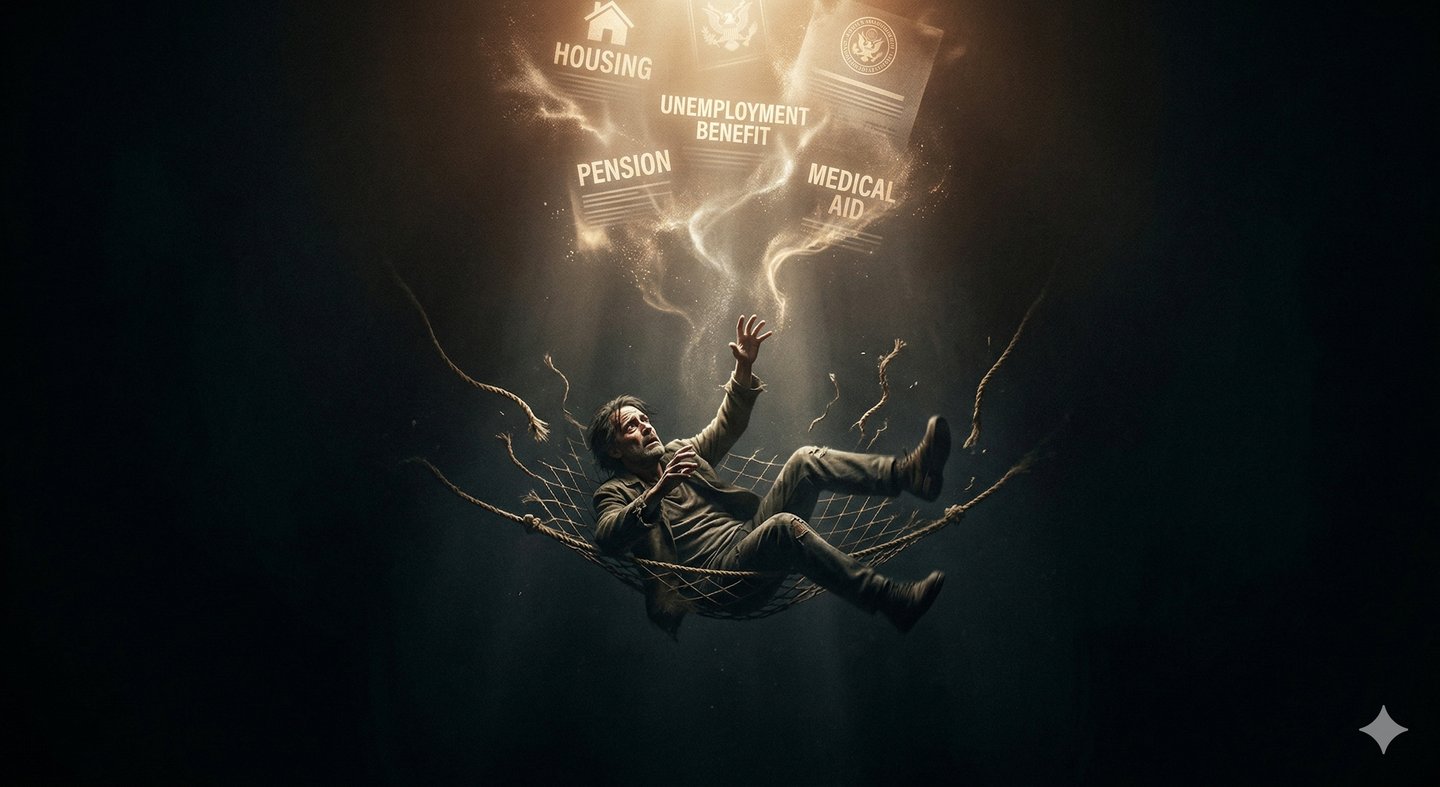
In theory, social security is meant to be a safety net — a system that supports people in times of need, whether it is old age, illness, unemployment, or financial distress. On paper, India has a wide range of social security schemes, from pensions and insurance programs to subsidies and welfare initiatives.
Yet, for millions of people across the country, the reality feels very different.
Instead of security, there is uncertainty.
Instead of support, there is struggle.
And instead of trust, there is doubt.
This raises an uncomfortable but important question:
Why does social security in India feel like it exists only on paper?
🧠 The Core Disconnect: Promise vs Experience
At the heart of the issue lies a simple but powerful gap — the difference between what is promised and what is actually experienced.
While schemes exist in policy documents and announcements, many people feel that when they truly need help, the system does not respond effectively. This creates a perception that social security is more symbolic than practical.
For the average citizen, it often feels like:
“Yes, the system exists… but it doesn’t really work for me.”
⚙️ A System Built for Scale, Not Depth
India’s population exceeds 1.4 billion people. Designing a system that reaches everyone is an enormous challenge.
To cover such a large population, schemes are often structured to distribute limited resources across a vast number of beneficiaries. While this ensures wider coverage, it also reduces the impact per person.
This leads to a system that is:
Broad in reach but shallow in impact
Focused on inclusion rather than adequacy
More about minimum support than meaningful support
As a result, benefits often feel too small to make a real difference in people’s lives.
🧾 Access Is a Struggle in Itself
Even when benefits are available, accessing them can be a challenge.
People frequently face:
Complex documentation requirements
Lengthy verification processes
Delays in approvals and disbursements
Dependence on intermediaries or local officials
For many, the effort required to claim benefits outweighs the benefit itself.
This creates a frustrating reality:
If help comes with so much struggle, does it even feel like help?
💼 The Informal Economy Challenge
A significant portion of India’s workforce operates in the informal sector. These are individuals who work without formal contracts, stable salaries, or documented contributions.
This includes:
Daily wage labourers
Small shop owners
Gig workers
Agricultural workers
Because they are not fully integrated into formal systems, they often:
Lack eligibility for structured benefits
Receive limited or inconsistent support
This creates a deep structural gap between those inside the system and those outside it.
🏥 Trust Deficit in Public Systems
Another critical factor is trust.
Over time, many people have developed scepticism toward public systems due to experiences such as:
Poor infrastructure in government hospitals
Delayed pension payments
Difficulty in insurance claims
Lack of accountability
As a result, even when services are available, people hesitate to rely on them.
Instead, they turn to:
Private healthcare
Personal savings
Family support
When people stop relying on a system, it begins to feel invisible — even if it exists.
💸 When Benefits Don’t Match Reality
Inflation steadily increases the cost of living, but social security benefits often do not keep pace.
This leads to situations where:
Pensions become insufficient for basic expenses
Subsidies lose their effectiveness
Financial support feels outdated
Over time, people begin to feel that the system has not evolved with real-world needs.
👨👩👧 India’s Real Safety Net: Family
In many ways, India’s strongest social security system is not institutional — it is emotional.
Families play a central role in providing support:
Parents support children through education and early careers
Children support parents in old age
Extended families share financial responsibilities
Because of this, people rely more on personal networks than on formal systems.
This makes government support feel secondary, even optional.
⚖️ The Reality: Not Useless, But Not Enough
It is important to understand that social security in India is not absent.
There are real efforts, real schemes, and real beneficiaries.
However, the system is:
Basic rather than comprehensive
Supportive rather than sufficient
Designed for survival, not stability
It works as a backup mechanism, not a dependable foundation.
🧠 The Emotional Truth
Beyond economics and policy, there is a deeper emotional layer to this issue.
People are not just looking for financial assistance. They are looking for:
Dignity in times of need
Ease of access without humiliation
Reliability they can trust
When these expectations are not met, the system feels disconnected from real life.
🔥 Final Perspective
India is still evolving — economically, structurally, and institutionally. Building a robust social security system for such a large and diverse population is a long-term process.
But the current reality is clear:
The system exists, but feels distant
It functions, but lacks strength
It supports, but does not fully secure
That is why, for many people, social security in India feels more like a policy than a practice.
🚀 The Bigger Question
As India continues to grow, the real challenge is not just expanding social security coverage
It is transforming it into something that people can actually depend on.
Because true social security is not just about providing benefits.
It is about creating a system where people feel:
👉 Protected
👉 Respected
👉 And genuinely supported
Bull or Bear Insight:
A nation’s strength is not just measured by its GDP or markets — but by how secure its people feel when they need support the most.